
TestGorilla Assessment Preparation
TestGorilla assessment practice helps candidates prepare with original Heycademy practice tests, clear explanations and practical test-day guidance.
Ready to begin?
Start preparing today
Build confidence with structured practice and clear guidance.
TestGorilla assessment practice helps candidates prepare with original Heycademy tests, clear explanations and practical review steps. Use your employer invitation as the source of truth, then log in to the Heycademy app when you are ready to practise.
TestGorilla assessments are configurable. One employer may choose a short mix of reasoning and communication tests; another may add coding, video, culture or custom questions. Use your invitation as the source of truth, then prepare the skill families that are most likely for your role.
TestGorilla assessment practice: what candidates should practise first
Use this page to move from reading into active Heycademy practice, review explanations and prepare for the assessment format shown in your invitation.
| Area | What to practise | Useful method |
|---|---|---|
| Problem solving | Priorities, constraints and simple operations | Write what the question is asking before choosing an answer. |
| Critical thinking | Evidence, assumptions and conclusions | Separate stated facts from what merely feels likely. |
| Numerical reasoning | Percentages, ratios, tables and rates | Identify the base value before calculating. |
| Attention to detail | Text or visual differences | Compare in short chunks instead of scanning randomly. |
| Communication judgement | Workplace or customer scenarios | Choose calm, professional and useful responses. |
| Role-specific tasks | Coding, language, support or job skills | Practise the underlying skill, not leaked questions. |
Important: TestGorilla assessments are configured by individual employers, so exact test combinations, timing, monitoring and question formats can vary. Use your invitation and on-screen instructions as the source of truth.
Before answering, identify whether the item asks for the best answer, the incorrect item, the next step or the strongest conclusion.
Decide whether you are solving a number, logic, detail, communication or role-specific task. The method depends on the skill.
After each mistake, identify the trap: wrong base value, missed keyword, unsupported assumption, rushed comparison or poor tone. Write it down before the next set.
Once the method is clear, practise with a timer so the real assessment feels familiar rather than sudden. Keep the timer strict, review calmly afterwards, and repeat the weakest skill first next time before adding harder mixed drills.
Choose your plan
Practice with confidence
Select the plan that matches your preparation goals.
What TestGorilla Assessment Practice Should Help You Do
Good practice should make the real assessment feel less unfamiliar. You should know how to read short instructions, manage timers, move between question types, check small details and recover quickly when one question feels difficult.
The goal is not to predict every question. The goal is to build reusable skills so that, whatever combination your employer selected, you can work methodically instead of panicking.
After reading this section, pause and name the exact behaviour you want to improve: pace, accuracy, evidence checking, detail comparison or communication judgement. A specific target makes the next practice set more useful because you know what success should look like before you begin.
How TestGorilla Assessments Are Put Together
TestGorilla distinguishes between individual tests and a complete assessment. A test usually measures one skill area, while an assessment combines tests and sometimes custom questions chosen by the employer.
That is why two candidates can both say they took a TestGorilla assessment and still have very different experiences. Your invitation and assessment overview matter more than any generic description online.
Use this point as a mini-checklist during practice. If you miss an item, decide whether the cause was the instruction, the method, the timer or the review habit, then adjust the next set instead of simply repeating the same mistake.
What You May Be Tested On
Common preparation areas include problem solving, critical thinking, numerical reasoning, attention to detail, reading comprehension, communication judgement, personality, culture fit, coding and role-specific skills.
You do not need to prepare every area equally. Look at the job description and invitation, then put more time into the skills that match the role.
After reading this section, pause and name the exact behaviour you want to improve: pace, accuracy, evidence checking, detail comparison or communication judgement. A specific target makes the next practice set more useful because you know what success should look like before you begin.
How to Start Your Preparation
Begin with a short diagnostic rather than a long study session. A quick test shows whether your main risk is calculation accuracy, evidence control, detail checking, time pressure or understanding workplace scenarios.
After that, practise weak areas untimed until the method is clear. Timed practice is useful, but only after you understand why your answers are right or wrong.
Do not treat this as theory only. Pick one relevant skill family, answer a few original questions and review why the weaker options were tempting. That is the part that transfers to the real assessment, especially when the employer’s exact test mix is not known.
Use Original Questions, Not Leaked Questions
TestGorilla states that candidates cannot preview official questions and answers before the assessment. Searching for copied questions is unreliable and can damage your preparation because it trains memory rather than judgement.
Original practice is safer and more useful. It prepares the reasoning pattern, the checking habit and the time-management skill without depending on live provider content.
The best way to apply this is to practise slowly first, explain your answer in one sentence, then repeat with a timer. Speed is easier to build after the method is clear, and timed practice is far less stressful when the steps already feel familiar.
A Practical Study Plan
Use the first session to understand your invitation and take a short mixed practice set. Use the second session for your weakest cognitive area. Use the third for attention to detail, reading or communication judgement, depending on your role.
In the final session, complete mixed timed practice and check your technical setup. This sequence gives you skill practice and test-day confidence without overcomplicating the process.
Keep a short mistake log while practising. Write the question type, the error pattern and the rule you will use next time. This makes improvement visible instead of vague, and it gives you something concrete to review before test day.
How to Use Explanations Properly
Do not just mark an answer as wrong and move on. Write down the reason: wrong base value, missed keyword, unsupported assumption, rushed comparison or unclear instruction.
A short repair note turns each mistake into a rule you can reuse. That is where most improvement comes from.
Do not treat this as theory only. Pick one relevant skill family, answer a few original questions and review why the weaker options were tempting. That is the part that transfers to the real assessment, especially when the employer’s exact test mix is not known.
Technical Setup and Monitoring
Depending on employer settings, your assessment may involve camera, microphone, full-screen mode, identity checks, video responses or periodic snapshots. These settings are not the same for every candidate.
Prepare your room, internet connection, browser, charger and quiet time before you begin. Technical stress can make easy questions feel harder.
The best way to apply this is to practise slowly first, explain your answer in one sentence, then repeat with a timer. Speed is easier to build after the method is clear, and timed practice is far less stressful when the steps already feel familiar.
When Paid Practice Makes Sense
Paid practice makes sense when you know what you need to improve. If the quick test shows repeated numerical errors, slow detail checking or weak critical-thinking logic, a focused plan can save time.
Use the pricing options only after you understand your preparation gap. The best plan is the one that helps you practise the sections most relevant to your invitation and role.
Make this practical by completing a short original drill, reviewing the explanation and writing one repair rule before moving on. That turns reading into a skill you can use under time pressure, and it stops preparation from becoming passive scrolling through advice.
Final Readiness Checklist
You are ready when you can explain your common mistakes, keep your pace under time pressure, and understand the rules shown in your assessment invitation.
You should also know what you will do if a question feels difficult: make the best supported choice, submit calmly and keep moving.
Use this point as a mini-checklist during practice. If you miss an item, decide whether the cause was the instruction, the method, the timer or the review habit, then adjust the next set instead of simply repeating the same mistake.
Candidate Preparation by Role and Skill
If your assessment is for a customer-facing role, give extra time to communication judgement, reading comprehension and attention to detail. Those sections often reward calm wording, accurate interpretation and careful checking. Practise by reading short customer scenarios and choosing the response that acknowledges the issue, gives a useful next step and avoids defensiveness.
If your assessment is for an analyst, operations, finance or data role, prioritise numerical reasoning, problem solving and critical thinking. You do not need advanced mathematics for every item, but you do need to know which value is the base, what the question is asking and whether a conclusion is actually supported by the information given.
If your assessment is for a technical or developer role, prepare role-specific tasks alongside general reasoning. Coding or technical questions can appear beside attention, logic or communication tasks. A strong preparation plan keeps your technical skill sharp while also training the short, timed reasoning style that many candidates underestimate.
If your assessment is for a remote or fast-moving role, test-day setup deserves serious attention. A quiet workspace, stable connection, camera permission, microphone permission, charger and browser readiness can protect your score by protecting your focus. Technical problems are not preparation problems you want to discover after the timer starts.
Use explanations as your main learning tool. A correct answer without a reason is fragile because you may not repeat it under pressure. A wrong answer with a clear repair note is useful because it shows exactly what to change next time. The best candidates get better by reviewing the cause of errors, not by simply doing more questions.
A simple preparation rhythm works well: diagnose, practise, explain, time, review. First find the weak area. Then practise it slowly. Then explain each mistake. Then use timed sets. Finally, review whether the same mistake keeps appearing. This rhythm is more reliable than doing long random practice sessions and hoping confidence appears.
Do not compare your preparation too closely with another candidate’s story. Their employer may have selected different tests, settings and custom questions. Use other experiences only as broad context. Your own invitation, job description and practice results are stronger signals for how you should prepare.
The final goal is controlled performance. You want to open the assessment already knowing how you will read instructions, handle timers, compare details, calculate carefully, judge evidence and respond to workplace scenarios. That is what candidate-focused TestGorilla practice should give you: not certainty about every question, but confidence in your method.
For numerical reasoning, spend time on everyday workplace calculations: percentage changes, totals, differences, rates, averages and simple table interpretation. Write the operation before you calculate. Many candidates know the maths but lose marks because they answer a slightly different question from the one asked.
For critical thinking, practise reading short business statements and asking what is proved, what is suggested and what is not supported. The strongest answer is often narrower than the most attractive answer. This is especially important when choices include words such as always, must, proves or only.
For attention to detail, create short drills with codes, order numbers, dates and addresses. Compare from left to right, then check the middle again. If you keep missing the same kind of difference, make that your first check in the next set.
For communication judgement, practise choosing responses that are respectful, specific and useful. Good workplace answers usually acknowledge the issue, avoid blame, explain the next action and stay realistic. This is a skill you can practise without pretending there is one perfect personality profile.
For personality and culture questions, prepare by understanding yourself rather than by trying to perform a fake version of the ideal candidate. Read carefully, answer consistently and think about how you usually behave at work. Honest consistency is safer than guessing what every employer wants to hear.
For role-specific or coding tasks, combine skill refreshers with timed practice. The employer may care about accuracy, speed, clarity or practical judgement. Do not spend all your preparation on general aptitude if the role clearly requires a technical or job-specific skill.
A useful final week does not need to be complicated. Use one session for a diagnostic, one for reasoning, one for attention and reading, one for communication or role-specific practice, and one for a mixed timed run. Keep each session focused enough that you can review properly afterwards.
On the day before the assessment, avoid cramming new question styles late at night. Review your mistake log, repeat a short set from your weakest area, and prepare your device. A rested candidate who knows their method will usually perform better than a tired candidate who completed too many random questions.
During the assessment, do not let one uncertain answer change your whole mood. Timed assessments reward recovery. If an item is unclear, use the best method available, submit the strongest supported answer and reset for the next question. Your preparation should train that reset.
After each Heycademy practice session, ask three simple questions: which skill cost me the most time, which mistake repeated, and what rule will I apply next time? Those answers give you a practical preparation plan without needing to guess the employer’s private scoring decisions.
If you only have one evening, prioritise the areas that create the biggest risk: reading instructions, numerical basics, attention to detail and technical setup. A short, disciplined session in those areas is better than browsing many unrelated resources without practising.
If you have several days, rotate skill families so you do not become comfortable with only one question type. TestGorilla assessments can feel demanding because candidates may need to switch quickly between different tasks. Mixed practice trains that switch and helps you stay composed when the format changes under real time pressure and focus.
Related TestGorilla Guides
Use these guides when you want to focus on one part of your preparation.
Frequently Asked Questions
Is every TestGorilla assessment the same?
No. Employers configure assessments from tests and custom questions, so your exact sections, timing and monitoring can vary.
Can I practise with official live TestGorilla questions?
No. TestGorilla candidate guidance says previews of official questions and answers are not provided. Use original practice to build the skill.
What should I practise first?
Start with a short mixed diagnostic, then practise the weakest area: numerical reasoning, critical thinking, attention to detail, communication judgement or role-specific tasks.
Can TestGorilla use a camera or microphone?
It can if the employer enables those settings. Follow the equipment and integrity instructions shown in your invitation and assessment screen.
Is Heycademy affiliated with TestGorilla?
No. Heycademy is an independent preparation resource and is not endorsed by TestGorilla.
Where can I continue practising?
Supporting guides include a link to the Heycademy app. You can use it for timed practice, explanations and focused review.
Final Preparation Note
Use official TestGorilla and employer instructions as the source of truth for your real assessment. Heycademy is not affiliated with or endorsed by TestGorilla.
This page uses original examples and preparation guidance. It does not reproduce official, live or competitor questions.
Do not treat this as theory only. Pick one relevant skill family, answer a few original questions and review why the weaker options were tempting. That is the part that transfers to the real assessment, especially when the employer’s exact test mix is not known.
Sample assessment questions
TestGorilla Assessment
Prepare for your TestGorilla assessment with realistic practice tests covering the most commonly used hiring assessments, including Problem Solving, Numerical Reasoning, Critical Thinking, Abstract Reasoning, Reading Comprehension, Working with Data, Attention to Detail, Spatial Reasoning, and Situational Judgement. Practice under timed conditions, improve your performance with detailed explanations, and build confidence before your pre-employment assessment.
Section 1
Numerical Reasoning
Percentages, ratios, tables, charts, and business maths.
A company's monthly sales increased from $150,000 to $195,000 over 6 months. What was the average monthly percentage increase in sales, assuming it increased at a constant rate?
Show answer
Correct answer: 4.5%
Using compound growth formula: Final = Initial × (1 + r)^6 → 195,000 = 150,000 × (1 + r)^6 → (1 + r)^6 = 1.3 → 1 + r = 1.3^(1/6) ≈ 1.043 → r ≈ 4.3%.
A company's annual report shows the following data (in $000): Revenue: 1,200; Cost of Goods Sold: 720; Operating Expenses: 300; Interest Expense: 60; Tax Rate: 30%. What is the company's net profit after tax?
Calculate Net Profit = (Revenue – COGS – Operating Expenses – Interest) × (1 – Tax Rate)
Show answer
Correct answer: $84,000
Profit before tax = 1,200,000 – 720,000 – 300,000 – 60,000 = 120,000. Net profit = 120,000 × (1 – 0.3) = 84,000. Correction: The correct net profit is 84,000, so option A is correct.
Using the Economic Order Quantity (EOQ) formula EOQ = sqrt((2 × Demand × Ordering Cost) / Holding Cost), where annual demand is 10,000 units, what is the EOQ?
A company orders 10,000 units of a product at $15 per unit. The holding cost per unit per year is $2, and the ordering cost per order is $500.
Show answer
Correct answer: 2,236 units
EOQ = sqrt((2 × 10,000 × 500) / 2) = sqrt(5,000,000) ≈ 2,236 units.
Section 2
Verbal Reasoning
Reading comprehension, inference, statements, and arguments.
A manager states that employees who work overtime are more productive. What assumption underlies this statement?
The manager believes overtime work correlates with higher productivity.
Show answer
Correct answer: Working longer hours directly increases productivity.
The assumption is that longer working hours (overtime) lead to increased productivity, which may not always be true.
What assumption underlies the argument that increasing the minimum wage will reduce poverty?
The argument states that raising the minimum wage will provide low-income workers with more money, which will reduce poverty levels.
Show answer
Correct answer: Employers will not reduce employment levels in response to higher wages.
The argument assumes that employers will not cut jobs or reduce hours when wages increase; otherwise, the intended poverty reduction might not occur.
A policy mandates that all employees must complete a cybersecurity training course annually. Which assumption is this policy based on?
The policy aims to reduce cybersecurity risks through training.
Show answer
Correct answer: Regular training will reduce the likelihood of security breaches.
The policy assumes that annual training effectively lowers security risks; if training does not impact behavior, the policy would be ineffective.
Section 3
Logical Reasoning
Patterns, sequences, arrangements, and abstract logic.
If all employees who work on Project X must attend the Monday meeting, and John does not attend the Monday meeting, what can be concluded about John?
Show answer
Correct answer: John does not work on Project X
Since all employees working on Project X must attend the Monday meeting, and John does not attend, John cannot be working on Project X.
Given the symbols: '^' means 'and', 'v' means 'or', and '~' means 'not', which of the following is the negation of the statement 'P ^ Q'?
Apply the negation to the conjunction using symbolic logic rules.
Show answer
Correct answer: ~P v ~Q
The negation of 'P and Q' is 'not P or not Q' by De Morgan's law, which is '~P v ~Q'.
If the symbol '@' means 'implies', and the statement 'A @ B' is false only when A is true and B is false, what is the truth value of 'X @ Y' if X is false and Y is false?
Symbol '@' means logical implication: true unless true implies false.
Show answer
Correct answer: true
Implication is false only when the antecedent (X) is true and the consequent (Y) is false. Here X is false, so 'X @ Y' is true regardless of Y's value. Hence, option A is correct.
Section 4
Data Checking
An employee attendance report shows John Doe clocked in at 9:00 AM and clocked out at 5:00 PM on March 15. The system log shows a logout time of 4:45 PM for John Doe on the same day. What is the most accurate conclusion?
Attendance Report:
Employee: John Doe
Date: March 15
Clock-in: 9:00 AM
Clock-out: 5:00 PM
System Log:
User: John Doe
Logout Time: 4:45 PM
Show answer
Correct answer: Both records are correct; John Doe logged out early but stayed on premises.
The system logout time is earlier than the attendance clock-out time, indicating the attendance report likely has an error or was not updated to reflect the actual logout time.
A software system processes employee records where each record must have a unique Employee ID and a valid email address. Given the following records, which entry contains an error?
Employee Records:
1. ID: E12345, Email: john.doe@example.com
2. ID: E12346, Email: jane.smith@example.com
3. ID: E12345, Email: mike.jones@example.com
4. ID: E12347, Email: lisa.brown@company
Note: Valid emails must contain '@' and a domain suffix.
Show answer
Correct answer: Record 3 has a duplicate Employee ID
Record 3 duplicates the Employee ID E12345 already used in Record 1, violating the uniqueness requirement. Additionally, Record 4's email is invalid because it lacks a proper domain suffix after '@'. However, the question asks for the entry containing an error, and the duplicate ID in Record 3 is the primary error.
A purchase order lists the following items and quantities: 15 units of Product A at $12.50 each, 10 units of Product B at $20.00 each, and 5 units of Product C at $7.80 each. The total amount on the invoice is stated as $517.50. Which value is incorrect?
Purchase Order:
– Product A: 15 units @ $12.50
– Product B: 10 units @ $20.00
– Product C: 5 units @ $7.80
Invoice total: $517.50
Show answer
Correct answer: The total invoice amount
Calculating the total: (15 x 12.50) + (10 x 20.00) + (5 x 7.80) = 187.50 + 200 + 39 = 426.50. The invoice total of $517.50 is incorrect and does not match the sum of the line items.
Section 5
Data Interpretation
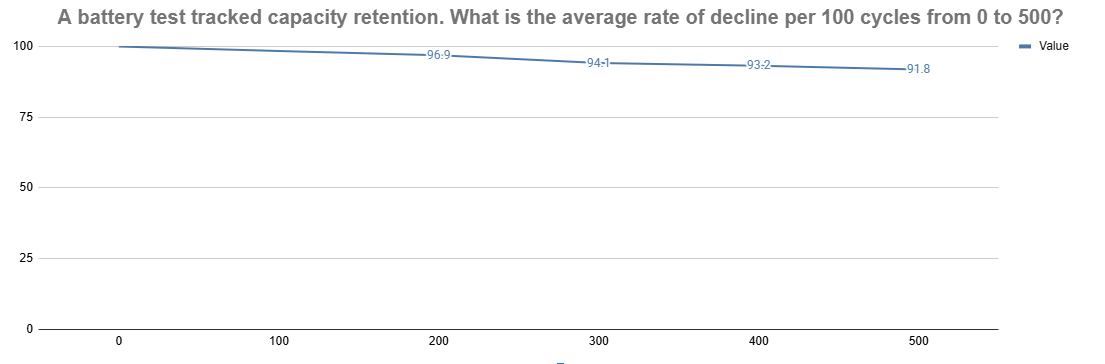
Select the correct answer based on the information shown in the graph.
Show answer
Correct answer: 1.64% per 100 cycles
Total drop from 0→500 = 100−91.8 = 8.20. Per 100 cycles (5 intervals) = 8.20/5 = 1.64%.
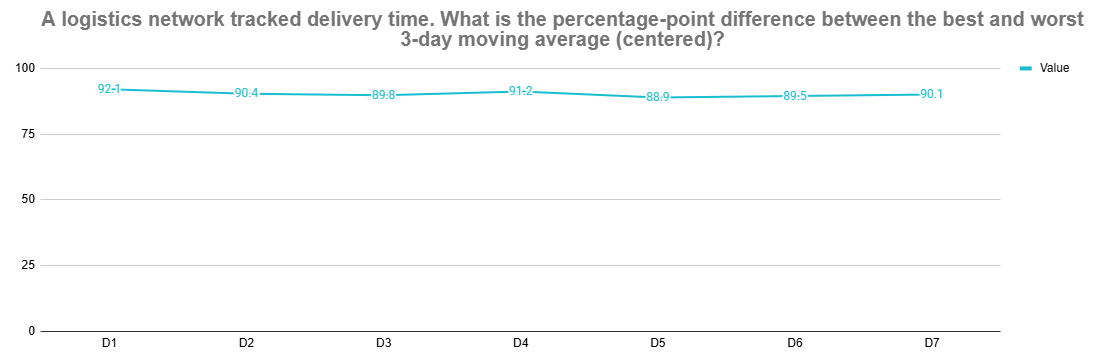
Select the correct answer based on the information shown in the graph.
Show answer
Correct answer: 1.27
3-day moving avgs: [90.77, 90.47, 89.97, 89.87, 89.5]. Best(min)=89.50, Worst(max)=90.77. Difference=1.27.
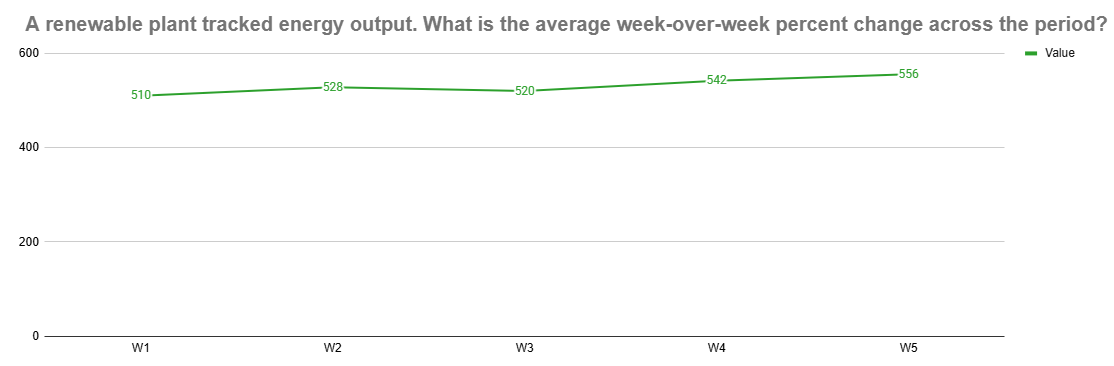
Select the correct answer based on the information shown in the graph.
Show answer
Correct answer: 2.21%
Week % changes: [3.53, -1.52, 4.23, 2.58]. Average = 2.21%.
Section 6
Critical Thinking
A report states: "Customer satisfaction increased by 10% last year." A consultant comments: "This clearly shows our service is superior to competitors." Identify the fact and the opinion.
The report provides a percentage increase; the consultant interprets the data.
Show answer
Correct answer: The 10% increase is a fact; the consultant's comment is an opinion.
The 10% increase is a measurable fact. The consultant's statement about service superiority is a subjective opinion.
A report states: 'Employee satisfaction increased by 15% after the new benefits were introduced.' Which statement is a fact?
Consider the report's claim about employee satisfaction.
Show answer
Correct answer: Employee satisfaction increased by 15%.
The 15% increase is a measurable fact; the other statements express opinions or feelings.
A manager states: "Our customer satisfaction score dropped by 5 points last quarter, which means our service quality is poor." Which part of this statement is an opinion?
Analyze the statement to separate fact from opinion.
Show answer
Correct answer: The drop indicates poor service quality.
The drop in score is a factual measurement; interpreting it as 'poor service quality' is a subjective opinion that may require further evidence.
Section 7
Situational Judgment
A new team member seems unsure about their responsibilities and is hesitant to ask questions. What should you do?
Scenario: You notice a new colleague is quiet in meetings and seems unsure about their tasks.
Prompt: What should you do?
Show answer
Correct answer: Approach them privately, offer support, and encourage them to ask questions whenever needed.
Supporting new team members and encouraging open communication helps them integrate and perform effectively.
During a project meeting, a team member criticizes your proposal with a direct tone but raises valid points. What should you do?
Scenario: A colleague challenges your idea in a straightforward manner, which may feel confrontational but includes useful feedback.
Show answer
Correct answer: Ask them to explain their concerns and discuss how the idea could be improved.
Engaging constructively with feedback, regardless of tone, promotes collaboration and improves outcomes while maintaining professionalism.
You accidentally receive confidential salary information about other employees. What should you do?
Scenario: A file containing sensitive salary data was mistakenly sent to your inbox.
Show answer
Correct answer: Delete or close the file, avoid sharing it, and report the accidental access to the appropriate person.
Protecting confidentiality and reporting the incident follows ethical standards and prevents misuse of sensitive information.
Section 8
Reading Comprehension
What is the primary purpose of the passage?
Artificial intelligence (AI) is transforming customer service by enabling faster response times and personalized interactions. Chatbots and virtual assistants handle routine inquiries, freeing human agents to focus on complex issues. While AI improves efficiency, companies must ensure technology complements rather than replaces human empathy to maintain customer satisfaction.
Show answer
Correct answer: To explain how AI enhances customer service efficiency while preserving human empathy.
The passage focuses on how AI improves customer service efficiency but emphasizes the need to maintain human empathy. Option A reflects this purpose, while others misinterpret or do not align with the passage.
What is the primary purpose of the passage?
In recent years, the integration of artificial intelligence (AI) into healthcare systems has transformed patient care and hospital operations. AI algorithms assist in diagnosing diseases more accurately by analyzing vast datasets, including medical imaging and patient histories. Moreover, AI-driven predictive analytics help hospitals manage resources efficiently, anticipating patient admission rates and optimizing staff allocation. Despite these advancements, ethical concerns about data privacy and algorithmic bias remain significant challenges. Healthcare providers must balance innovation with patient rights to ensure equitable and secure AI applications.
Show answer
Correct answer: To highlight both the benefits and challenges of AI in healthcare.
The passage discusses AI's positive impact on healthcare and also addresses ethical challenges, indicating a balanced overview rather than advocating replacement or technical specifics.
What is the main idea of the passage?
Many companies have shifted to hybrid work models to balance employee flexibility with the need for collaboration. While remote work offers benefits such as reduced commuting and increased job satisfaction, it can also create challenges in communication. To overcome these, organizations schedule regular in-person meetings and use digital tools to facilitate teamwork. This approach aims to combine the advantages of remote work with effective collaboration.
Show answer
Correct answer: Hybrid work combines flexibility with structured collaboration.
The passage explains that hybrid work balances flexibility and collaboration by combining remote work benefits with scheduled meetings and digital tools. Other options contradict or overstate the passage's content.